
Why meetings can harm employee well-being
Posted on 10 Dec 2025
Anyone working in an organisation knows it: meetings follow one after another at a frantic pace. On…
Posted on 13 Sep 2023
By Matthew Schulz, journalist, Institute of Community Directors

If embracing diversity is important to your organisation, working out ways to accommodate neurodiversity should be on your agenda.
As progressive organisations accept neurological diversity as a feature and not a flaw of human variation, the Institute of Community Directors Australia (ICDA) is aiming to help crack open assumptions about people who think differently, while showing you how knowledge of neurodiversity can help you lead better.
Neurodiversity spans the spectrum of autism, attention deficit hyperactivity disorder (ADHD), dyslexia, dyscalculia, dyspraxia, and Tourette syndrome, to name a few conditions.

As well as developing new resources and updating ICDA’s training materials, ICDA trainer and neurodiversity advocate Annabel Rattigan will host a free lunchtime “Welcome to Neurodiversity” webinar (November 21) as part of a personal and professional mission to help schools, not-for-profits and workplaces become more neuro-affirming.
Annabel’s knowledge of the field stems from her experience as a parent of “three amazing neurodivergent children”, as co-host of the podcast The Village Lantern, aimed at neurodiverse families, and in undertaking ADHD-specific training.
She believes neurological differences should be respected in the same way that people respect variations in gender, ethnicity, sexual orientation and disability status.
“As many as one in five of us are neurodivergent, yet among the organisations I work with there is often a complete absence of neurodiversity in policies and procedures about inclusion and diversity.
“Many not-for-profit leaders don’t really have this on their radar, but with our increasing focus on diversity at ICDA, we’re hoping to redress that.”
She said this lack of attention in the workplace stems from widespread shame and non-disclosure, which is not surprising considering recent studies showing that up to half of UK employers would hesitate to hire someone they knew was neurodivergent.
“For not-for-profits with limited resources, being able to engage neurodivergent people to tackle problems in innovative ways can be a big advantage.”
Fortunately, neurodivergence is beginning to lose its stigma.
Australian pop star Sia recently confirmed her autism diagnosis, declaring “only in the last two years have I become fully, fully myself”.
US singer Billie Eilish is another public figure who has been open about her neurodivergence, which for her means living with Tourette syndrome and synesthesia.
Well-known neurodivergent Aussies include entertainers Osher Gunsberg, Em Rusciano and Chloe Hayden, former Australian of the year Grace Tame, and author Amy Thunig.

Annabel believes organisations need to create psychologically safe environments for neurodivergent people through practices and policies that discourage discrimination and bullying, encourage inclusion, and enable people to work at their best.
Doing so means tapping into a massive talent pool, given that as many as 45% of autistic people report their skill levels are much higher than is required for their current job – many neurodiverse people are able to approach problems in a highly creative way.
“For not-for-profits with limited resources, being able to engage neurodivergent people to tackle problems in innovative ways can be a big advantage,” Annabel said.
“Organisations are missing out if they are not allowing for neurodiversity.”
Welcome to Neurodiversity webinar, Tuesday, November 21.
Posted on 10 Dec 2025
Anyone working in an organisation knows it: meetings follow one after another at a frantic pace. On…

Posted on 10 Dec 2025
As a qualified yoga instructor who learned the practice in her hometown of Mumbai, Ruhee Meghani…

Posted on 10 Dec 2025
Community Directors trainer Jon Staley knows from first-hand experience the cost of ignoring…

Posted on 10 Dec 2025
Stressed, overwhelmed, exhausted… if you’re on a not-for-profit board and these words sound…

Posted on 10 Dec 2025
The Institute of Community Directors Australia trains over 22,000 people each year, which gives us…

Posted on 03 Dec 2025
Many not-for-profit (NFP) board members in Australia are burnt out, overwhelmed and considering…
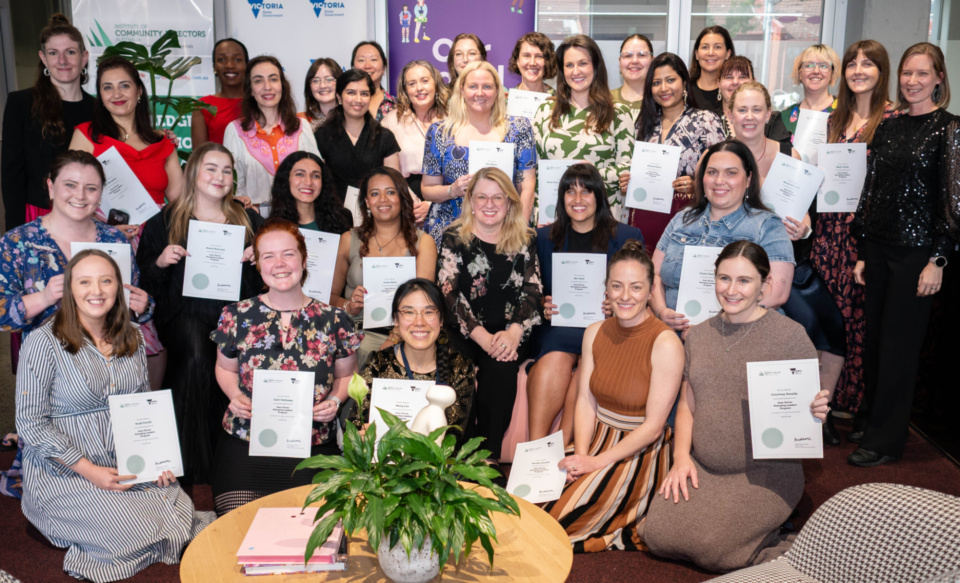
Posted on 26 Nov 2025
A roll call of Victoria’s brightest future leaders has graduated from a testing and inspiring…

Posted on 12 Nov 2025
At the Institute of Community Directors Australia, we believe that stronger communities make a…

Posted on 12 Nov 2025
Like many Community Directors members, Hazel Westbury is a community leader who isn’t easily…

Posted on 11 Nov 2025
I’ve seen what happens when fear of conflict wins out over taking a principled stand.

Posted on 11 Nov 2025
‘It’s not a question of enough, pal. It’s a zero-sum game. Somebody wins and somebody loses’.

Posted on 11 Nov 2025
Progressive economic Richard Denniss believes the constant hunt by governments for the political…